How to Launch a Membership Site with a Small Audience
What if you don’t need a huge audience or a giant content library to launch a successful membership?
Because that’s what a lot of entrepreneurs assume. They think they need thousands of followers, dozens of trainings, and a Netflix-sized vault of content before anyone will pay monthly.
But that’s simply not true.
In this post, I want to show you a much simpler way to think about starting a membership site. One that is lean, realistic, and actually supports the freedom you wanted when you became an entrepreneur in the first place.
And honestly? That matters more than ever. Recurring-revenue businesses have continued to grow faster than the broader economy, and Zuora’s 2025 Subscription Economy Index found that companies in its benchmark grew revenue 11% faster than the S&P 500 over the prior two years. The same report also found a 25% increase in unique subscribers over that period, with 68% of surveyed U.S. consumers saying they tried a new subscription for the first time in 2024.
So yes, memberships still work.
But the best memberships are not the ones with the most stuff. They’re the ones that deliver a clear result, with a clear path, in a way that doesn’t trap you on a content hamster wheel.
Why Most People Overcomplicate Memberships
There are two myths I hear all the time:
You need a big audience.
You need tons of content.
Those ideas sound logical. But they can actually stop you from launching something that could become a beautiful, recurring stream of revenue.
When I first started my membership, I didn’t have a huge audience. I had a small but growing one.
And I definitely did not have a massive content library.
Yet within a week of launching, I had 300 members and about $10,000 in recurring monthly revenue.
That kind of result is not the norm for everyone, of course. But it does prove something important: you can do a lot with less than you think.
That’s the real opportunity with memberships. You do not need to build the biggest thing. You need to build the right thing.
How Big Does Your Audience Really Need to Be?
The better question is not, “How many followers do I need?”
The better question is, “How many members do I need for this to be worth it?”
That number will be different for everyone.
It depends on:
Your membership price
How much access you’re offering
How much content you plan to create
How much time you want to spend maintaining it
But here’s a good starting point: aim for at least 30 founding members.
If your membership is $50 per month, 30 members would put you at about $1,500 in monthly recurring revenue.
That is not a full-time income for most people, but it is enough to prove the concept and start building momentum. And if you design the membership well, it should not need to consume your whole week.

A Simple Rule of Thumb
A good baseline is to expect about 10% of your launch list to join.
So if you want 30 members, build a launch list of 300 people.
If you want 50 members, build a launch list of 500 people.
That’s it.
Not 50,000 followers. Not a viral reel. Not a giant team.
A focused list of people who are genuinely interested in the result your membership helps them achieve.
Don’t Write Off a Small Audience
One of the biggest mistakes I see entrepreneurs make is dismissing their audience because it feels “too small.”
But small audiences can convert incredibly well when they’re engaged and specific.
A smaller group of the right people will usually outperform a larger audience of random people who only kind of know what you do.
This is especially true with memberships, because membership buyers are not just making a one-time purchase. They are opting into an ongoing relationship.
That means trust matters.
Clarity matters.
And relevance matters a lot more than sheer audience size.
So before you tell yourself, “I’m not ready yet because my audience is too small,” pause and ask:
Do I have a specific group of people who want a specific result?
If the answer is yes, you may be much closer than you think.
You Do Not Need a Giant Content Library
Now let’s talk about the other myth: content.
A lot of people assume they need to create an entire library before launching so that members will log in, see a huge vault of resources, and be wowed.
But a giant library can actually create the opposite experience.
It can overwhelm people.
When members log into a new program and see way too many choices, they often don’t know where to start. They get distracted. They consume a little of this and a little of that. And then they don’t get results.
That is a problem, because results are what keep members subscribed.
Not more content.
Not prettier modules.
Not fifty bonus trainings they never asked for.
More Content Is Not Always Better
If your membership feels like a cluttered closet, your members won’t feel supported. They’ll feel lost.

And when people feel lost, they leave.
That’s why a streamlined membership can actually outperform one with a huge library. Focus creates momentum. Momentum creates wins. Wins create retention.
So instead of asking, “How much content should I build before I launch?”
Ask this:
What is the minimum amount of content someone would need to make meaningful progress in the first month?
That is a much better question.
How Much Content Do You Need Before Launch?
Usually, one month of content is enough.
Really.
You do not need six months of lessons sitting there before you open the doors.
You do not need an enormous resource vault.
You just need enough content to give new members a strong start.
That could look like:
The first three modules of a program
One monthly workshop
One group coaching call
A simple action plan
A community space with clear next steps
That’s plenty.
The key is not the amount of content. The key is the expectation you set.
Set the Right Expectations
If people think they’re joining a giant on-demand content library and they only get a few lessons, they’ll be disappointed.
But if they understand they’re joining a guided program that will unfold over the next three, six, or twelve months, then those first few modules can feel exciting and valuable.
Same content.
Different expectation.
Completely different experience.
This is so important.
People don’t need endless content. They need confidence that they are in the right place, starting at the right step, and moving toward the right outcome.
The Best Memberships Feel Like a Path
One of the smartest ways to structure a membership is to make it feel like a path, not a pile.
That means your members should know:
Where to start
What to do next
What result they’re working toward
What to ignore for now
This is one reason curriculum-style memberships can work so well, especially in the early stages.
Instead of stuffing your site with every idea you’ve ever had, give members a simple sequence they can follow.
That clarity is incredibly valuable.
And from a business perspective, it also makes your membership easier to manage, easier to market, and easier to improve.
How Much New Content Should You Add Each Month?
This is where many entrepreneurs start to panic.
They imagine launching a membership means committing to:
Weekly coaching calls
Constant new courses
Endless office hours
A nonstop publishing schedule
No wonder so many people hesitate.
That sounds exhausting.
But it doesn’t have to look like that.
In fact, one of the best things about a well-designed membership is that it can be surprisingly simple to maintain.
Keep It Minimal and Valuable
Most members do not want an avalanche of new content every week.

They want a few valuable touchpoints that help them keep moving.
That might be:
One workshop per month
One group coaching call per month
One mini-course per month
A community discussion thread
A coworking or accountability session
That’s enough.
And in many cases, it’s better than enough.
Subscription businesses tend to grow best when they focus not just on getting customers in, but on continuing to deliver value after sign-up. Zuora’s research notes that successful high-growth subscription businesses often derive 70% to 80% of revenue from existing customers, which is a powerful reminder that retention matters just as much as acquisition.
So instead of asking, “How can I create more?”
Ask, “How can I help members get results with less friction?”
That question will lead you to a much healthier membership model.
What This Can Look Like in Real Life
At one point, I created a mini-course each month inside my membership.
That sounds big, but it was actually pretty simple.
Each month, I recorded about five short lessons, around five to ten minutes each, focused on helping members achieve one tangible next result in their business.
That was it.
The planning and recording took around five hours. Then the content was edited and uploaded.
For a membership generating around $10,000 a month in recurring revenue, that was an incredibly good trade.
And over time, as the content library grew, the new content creation became even lighter. Eventually, the ongoing value shifted more toward coaching, community, and implementation support, instead of constantly building new trainings.
That’s a much more sustainable model.
A Smarter Way to Launch Your Membership
If I were launching a membership from scratch today, here’s the simple approach I’d recommend:
1. Build interest before you build everything
Create a launch list of people who are specifically interested in your membership topic.
2. Decide your minimum viable member count
Know how many members you need for the membership to be profitable and sustainable.
3. Create just the first month of content
Build enough to help members make real progress right away.
4. Promise a path, not a library
Show members what they’ll get now, what’s coming later, and how the journey works.
5. Keep the monthly delivery light
Choose one or two core content formats you can maintain consistently.
6. Optimize for results, not volume
A focused membership with better outcomes will usually outperform a bloated one.
That’s the whole strategy.
It’s simple on purpose.
Because the whole point of entrepreneurship is not to build yourself a fancier prison. It’s to create freedom.
Final Thoughts
You do not need a massive audience.
You do not need hundreds of lessons.
You do not need to wait until everything is perfect.
What you need is a focused offer, a clear promise, a small group of interested people, and enough content to genuinely help them get started.
That’s it.
A membership can absolutely become a stable, recurring revenue stream in your business. But the version that works best is usually the one that is simpler, more focused, and more intentional than most people expect.
So don’t let the myths keep you stuck.
Start lean. Serve well. Help your members get wins.
And then build from there.
You really can create a membership that supports your life instead of taking it over.
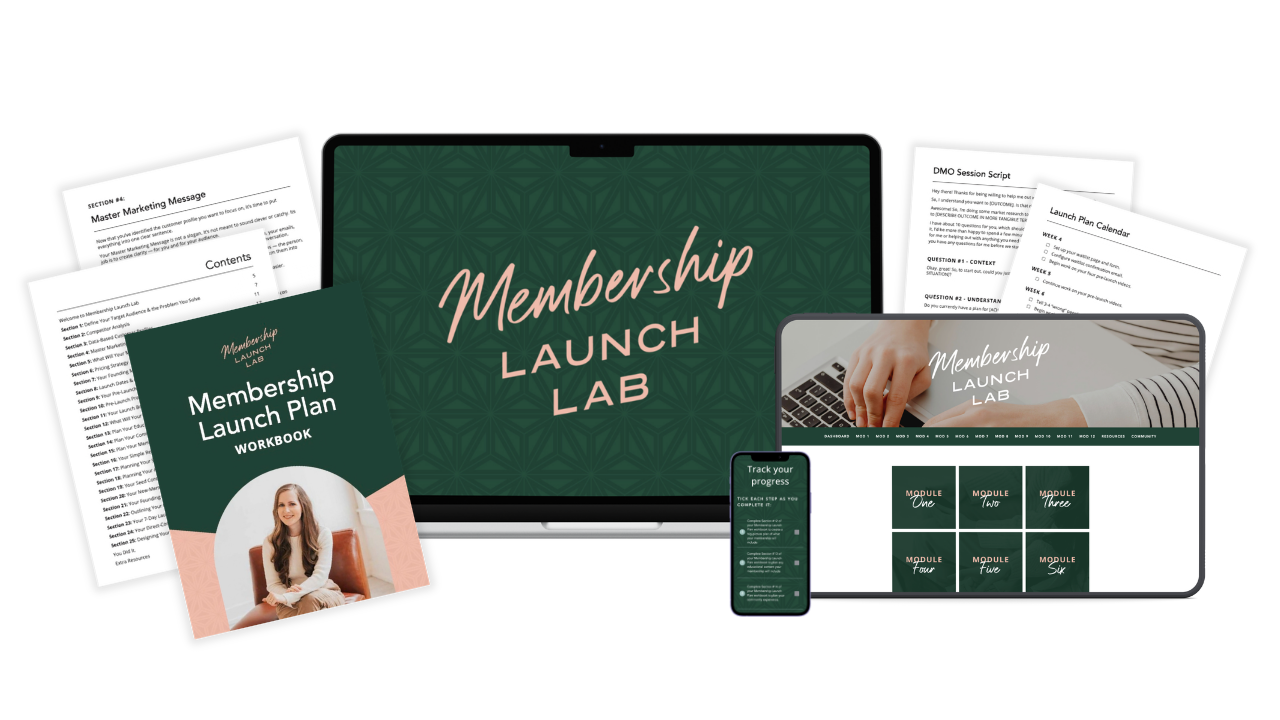
If you’re ready to stop overthinking your membership and finally build one that’s simple, focused, and profitable, join the waitlist for the next round of Membership Launch Lab. You’ll be the first to hear when enrollment opens (so soon!!)
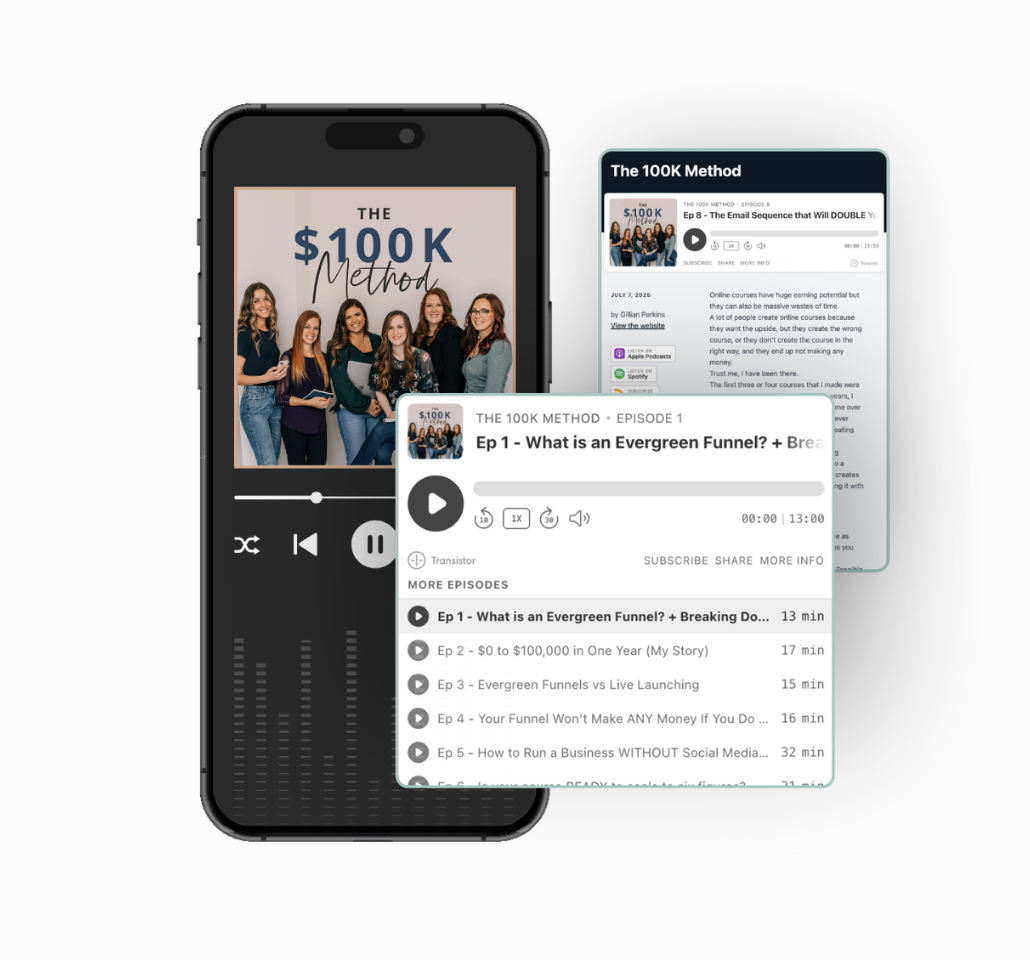
Free Limited-Series Podcast
I didn’t set out to make $100K. I just wanted a business that paid the bills and gave me freedom. Over the years, I’ve refined the simple systems and strategies that made it possible… and they’ve helped hundreds of other entrepreneurs do the same.
In The $100K Method podcast, I share how I did it — and how you can, too.