Email still drives about 90% of online sales, especially when it comes to digital products. And in my business, it's even higher - around 95%.
A lot of my sales actually happen live, on webinars and Q&A call,s and launch promotions. But the only reason anyone shows up to those in the first place is because an email invited them. So, without email marketing, I'd only be making about 5% of what I make now.
If your website isn't making sales right now, or you're trying to move a course or a product with social media alone and it's just not converting, it's probably not you. Nor is it that the economy is bad or that courses don't sell anymore. You're just leaving a really important tool sitting in the bag.
So, let’s fix that. In this article, I’m handing over the exact 7-email sequence I use to sell my digital products. We’ll also be getting into the psychology behind each email and how to schedule the whole thing so it actually converts.
Email 1: The offer announcement
The first email in the sequence tells your subscribers that your product is live! Be sure to explain what it is and how it helps them.
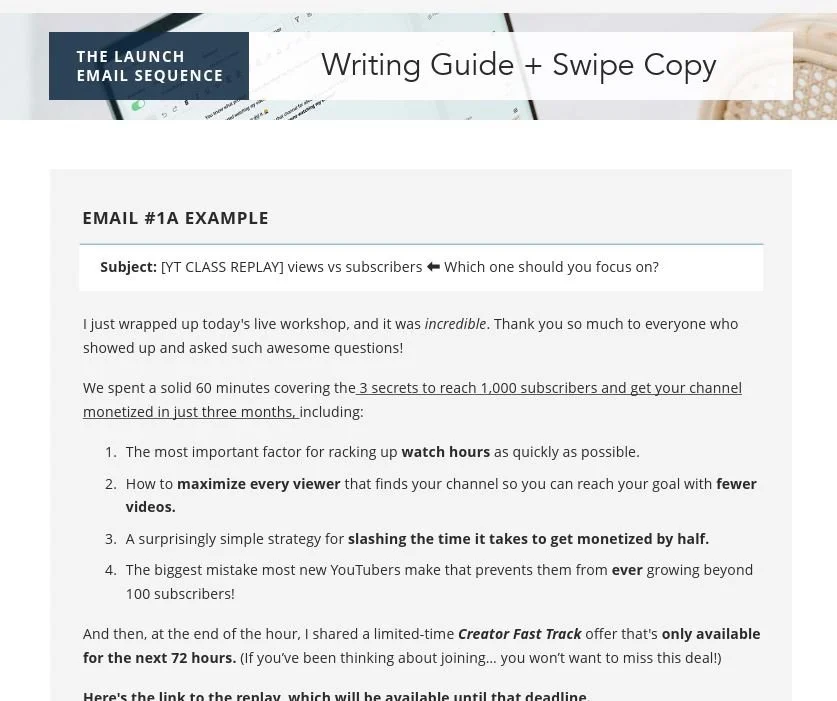
If you're sending this after a webinar, open with a quick recap. Something like: "I just wrapped up today's live workshop and it was incredible. We spent a solid 60 minutes covering [the 3 things], and at the end of class I shared our limited-time offer, available for the next 72 hours."
If you're not doing a webinar, you can go straight to the announcement: "It's the moment we've all been waiting for. Enrollment is officially open. If you're ready to [get the result], now is the time to take action."
Either way, this email exists to say: heads up, this is what we're talking about. The real selling happens next.
Notice what this email is not doing. It's not trying to close the sale. It's not stacking up bonuses or building a case. It's just telling your list, clearly, that the doors are open and what's on the other side of them. Save the convincing for email #2.
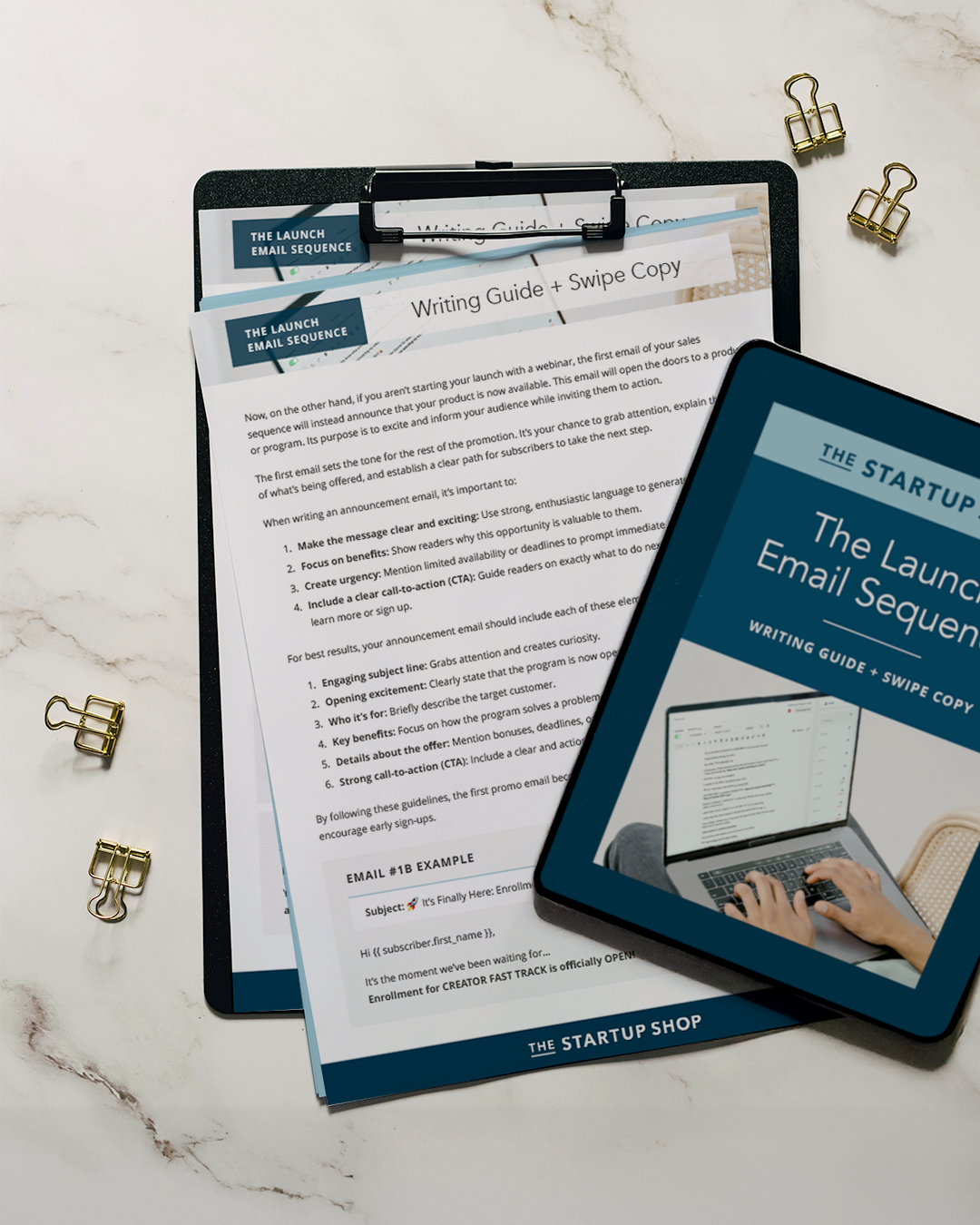
Want the actual swipe copy, not just the breakdown? I turned this whole sequence (plus a detailed guide for writing your own version!) into a free download. Grab your copy here: https://www.gillianperkins.com/free-launch-email-sequence-sign-up
Email 2: Diagnose the problem
This one's counterintuitive. When you're selling something, it feels natural to talk about the product: the features, the benefits, how great it is. But roughly two-thirds of your launch copy should actually be about your customer and the problem they're facing right now. That's the real reason anyone buys.
Think about a doctor's appointment. You fill out a questionnaire, a nurse asks more questions, and then the doctor asks some of the same questions again. It can feel slow. But it's also exactly why you trust the diagnosis at the end of it. Now imagine the doctor skipped all of that, handed you a bottle of pills, and said "these are great, take one a day, that'll be $50." You wouldn't trust it. You'd have no confidence those pills were for your specific problem.
That's what happens when we sell online by only talking about how great the product is. We skip the part where we prove we understand the problem, and we jump straight to price and how to buy. The second email in this sequence is where you avoid that. You describe the problem back to your reader in language they actually use (which means you need to have talked to real customers before you write this), so they feel like you get it before you ever pitch the solution.
This is also the email where you can afford to tell a real story, including your own. If you've ever struggled with the exact problem your product solves, this is the place to say so, in detail, with the specific frustrating parts included. People don't trust a solution from someone who's never felt the problem. They trust it from someone who's been there and found a way out.
Email 3: The case study
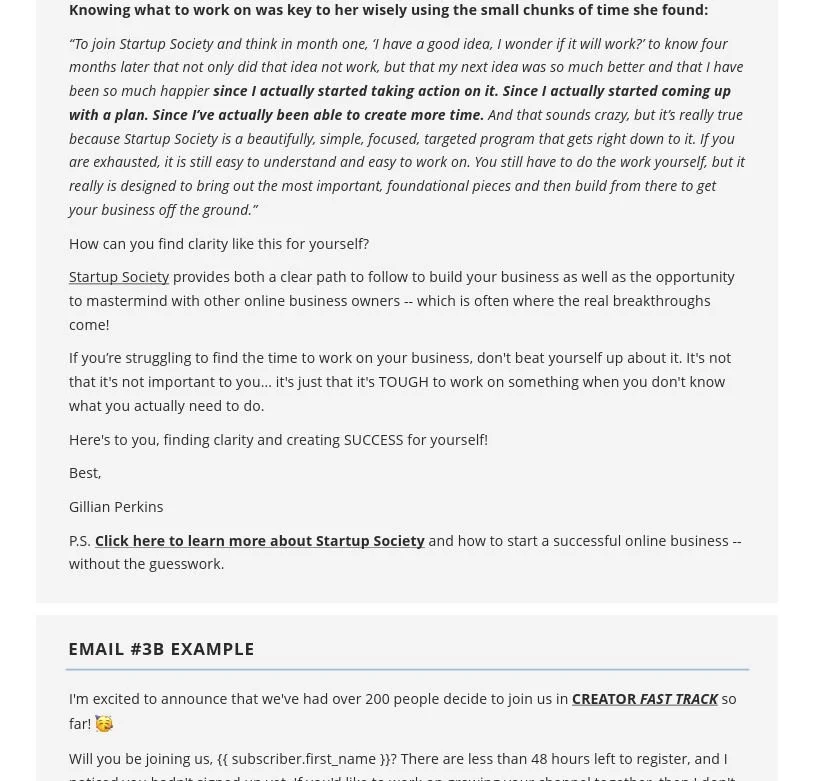
Now you start building belief that the product actually works, using a real story from someone who's used it. This does double duty: it's social proof, like an Amazon review for your offer, and it keeps your reader relating to someone who was struggling with the exact same problem before they found a way through it.
You don't need five case studies here. One well-told story, with a real name and a specific before-and-after, is more compelling than a whole wall of testimonials.
Email 4: The FAQ email
On the surface, this email exists to answer common questions: how long will this take, what if I already know some of this, can I start next month. But there's something deeper going on… because almost every question your audience asks is really a version of one question: will this work for me?
"How long will this take?" usually means "I'm not sure I have enough time to make this work." "How much does it cost?" usually means "Since I’m not sure if this will work, I’m trying to decide if it’s worth the risk." Once you see that, this email stops being a logistics list and becomes your chance to argue, gently, for why your product really will work for the specific person reading it.
Email 5: Testimonials
This one looks similar to your case study email, but it focuses more on the product itself rather than the problem. Think Amazon reviews: other people giving your program their stamp of approval. More proof, from more angles, keeps building the case.
Email 6: What's holding you back (plus the fix)
Here you name the one obstacle most of your audience believes is standing in their way, whether that's time, confusion about where to start, or doubt they can pull it off. Don't try to tackle every obstacle. Pick the biggest one, sit with it for a minute, and then present your product as the way through it.
Email 7: The last chance email
Short and simple. This is your deadline email: the sale is ending, enrollment is closing, and this is the last shot. You can briefly recap the offer, but the real job of this email is urgency, not information.
Want the actual swipe copy, not just the breakdown? I turned this whole sequence (plus a detailed guide for writing your own version!) into a free download. Grab your copy here: https://www.gillianperkins.com/free-launch-email-sequence-sign-up
How to Time Your Sales Sequence
I typically send this seven-email sequence over 72 hours, sending about two emails per day. That’s what I’ve found generates the most sales.
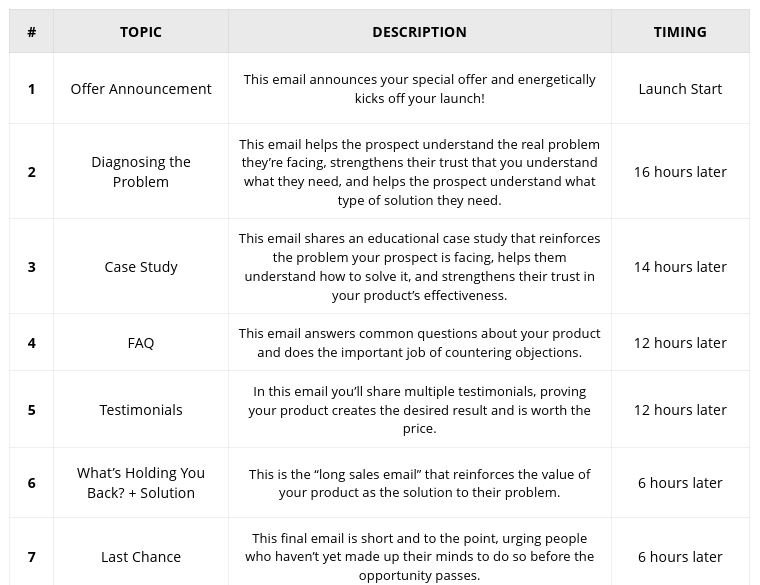
You don't have to run it that fast, though. For example, you could stretch it to seven days instead, if you want. In that case, use the same emails - just spread them out over an entire week and add one more email on the final day. (It always helps to send two or even three emails on the last day of a promotion: one chattier reminder in the morning, followed by a true last-chance email a couple of hours before the offer actually closes.)
The number of days isn't the important decision here. The important decision is that your audience always knows where they are in the sequence and how much time is left. A confused reader doesn't buy. A reader who knows exactly when the doors close, and why, does.
Don't Stop at the Webinar
If you're using a webinar as part of your launch, don't assume the webinar is where all your sales will happen. In my business, about half of my launch sales typically come from the webinars themselves, live or on replay. The other half comes from the follow-up email sequence you just read through. I call it my "double your sales" sequence, because that's roughly what it does: however many sales we make on the webinar, we typically make right about that many more in the three to seven days that follow.
I get why this step gets skipped. By the time the webinar is over, you're tired, and it feels like everyone who wanted to buy already has. But the people who didn't buy on the webinar aren't a lost cause. A lot of them were actually interested and just weren't ready to decide in the moment, on camera, with everyone watching. The follow-up sequence is where they get to make that decision on their own time, which is exactly why it converts as well as it does.
The part before the pitch
There's one more piece that matters as much as any single in the launch sequence email: and that’s your warm-up sequence, sent before the launch even opens.
The fact is, most people decide whether they're going to engage with your launch emails long before you ever get to the pitch. If the first few emails in your inbox don't earn attention, the rest of the sequence never gets read, no matter how good it is.
I usually send about four weeks of warm-up emails before a launch, with one or two emails per week. These emails don’t pitch anything. They just tell stories, educate, and create context for whatever the product is about to solve. Then, in the week or so before the cart opens, I switch into promoting a webinar. We run the webinar live, then this seven-email sequence goes out right after.
Put all of it together and you've got three distinct phases: the warm-up, which earns the right for all the emails that follow to be read; the webinar promo and the webinar itself, which builds real understanding of the offer and drives many of the sales; and this seven-email sequence, which turns that understanding into even more sales. Each phase depends on the one before it. A brilliant sales sequence sent to a cold list will always underperform the same sequence sent to people who've spent a month thinking about the problem your product solves.
If you skip the webinar entirely, these seven emails still work as a standalone sequence, and honestly, that's what I'd recommend if you're just getting started with this. If you do run a webinar, use them as your follow-up. Either way, don't leave this tool in the bag.
Want the actual swipe copy, not just the breakdown? I turned this whole sequence (plus a detailed guide for writing your own version!) into a free download. Grab your copy here: https://www.gillianperkins.com/free-launch-email-sequence-sign-up

Need to grow your audience?
If you'd like the time you're already putting into your content and your business to actually start paying off, I'd love for you to apply to work with me: https://gillianperkins.com/apply-to-grow